
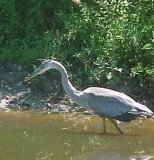
Adult Great Blue Heron Below

Younger Great Blue Herons Below
And one Baby Bull Frog.
 |
 |
 |
About these big birds
Profile
Great blue herons are waders, typically seen
along coastlines, in marshes,
or near the shores of ponds or streams
Though they are best known as fishers,
mice constitute a large part of their diet,
and they also eat insects and other small creatures.
*************************************************
Great blue herons' size (3.2 to 4.5 feet/1 to 1.4 meters)
And wide wingspan (5.5 to 6.6 feet/1.7 to 2 meters),
They can cruise at some 20 to 30 miles (32 to 48 kilometers) an hour.
Though great blue herons hunt alone,they typically nest in colonies
They prefer tall trees, but sometimes nest in low shrubs.
Females produce two to seven eggs,
which both parents protect and incubate.
Chicks can survive on their own by about two months of age.
****************************************************
Facts
Type: Bird
Diet: Carnivore
Average lifespan in the wild: 15 years
Size: Body, 3.2 to 4.5 ft (1 to 1.4 m);
Wingspan, 5.5 to 6.6 ft (1.7 to 2 m)
Weight: 4.6 to 7.3 lbs (2.1 to 2.5 kg)
Group name: Colony
****************************************************
Breeding Habitat: Marshes, swamps, tidal flats,
shallow coastal bays; shores of ponds,
lakes, and rivers.
Prefers habitats that include tall trees for nesting.
Please Visit The Dropdown Menu Rooms
Below
All Photos on this page were taken by me
If you wish, You may use them for educated use.
Please do not claim them as your own.
Page by Gardenladyx
Updated From March 31,2009
To April 11,2011
|
|


